
India Adventure #12 New Year’s Eve in Udaipur

Dec 31

This morning we got to wake up 15 minutes later for yoga class – Hooray! These classes have been very different from our classes at home. There is very little instruction and no modifications are offered. She did some hands-on adjustments i.e. pushing some people deeper into their poses. If anyone could not execute the pose perfectly, her comment was: “If you do this everyday, you will then be able to do it”. I tried not to laugh out loud when she was teaching us alternate nostril breathing. Many of us were quite congested with colds, and were having trouble breathing through one nostril or the other – when this was mentioned, the answer was the same: If you do this everyday, your nose will not be blocked.” Overall, I really enjoyed the classes, and picked up a few pearls I will use in my classes. It was an eye-opener though. I am looking forward to seeing how the classes will be taught in Kerala on my retreat.

I was trying to fly under the radar, and not realizing this, Hari’s son Al, outed me to the teacher on the first day and told her I was a yoga instructor back home. She seemed shocked, in fact, asked three times to make sure that I was actually the person he was talking about. I realize I do not look like your average yoga instructor  – this did not bother me in the least, in fact, I found it quite amusing. yoga is for everyone, not just the super-fit.

We started our sightseeing after another amazing breakfast. The first stop was an inactive Hindu temple called Saas Bahu. It was built in the 10th century, and was destroyed by a moghul king in the13th century. The relief carving work in the temple was incredible, although all of the faces have been cut off by the Moghuls, according to the prohibition in Islam of “graven images”. 

Our next stop was an active Vishnu temple, built in the 7th century.  Because it is an active temple, we were not allowed to wear shoes, bring in our cameras, or wear any leather. Within this temple complex there are a total of 108 temples – a spiritually significant number in Hinduism. (put in examples here) Every Hindu god has their own special day, and as luck would have it, Monday is Vishnu’s day. The Royal family of Udaipur comes to this particular temple every Monday to pray. The temple was very busy – lots of people, lots of monkeys scampering around, and there were drummers and other traditional instruments being played as the crowd lined up to pay their respects at the shrine. It was an interesting, colourful experience.

There were many relief carvings at this temple, each depicting a different story. The guide showed Aubrey a relief carving showing forced bestiality as punishment for rape.  I felt badly for the animal being used for the punishment.

We had lunch at an outdoor restaurant called Urban Dhaba. We were the only patrons, which might normally be a red flag, but the food was a delicious assortment of homemade “Rajasthani village specialties”  Our host, Hari explained that we would taste food here that we will not find anywhere else. It was wonderful.

Our next stop was the Monsoon Palace. It is high atop a hill, and is often above the clouds. The views of the surrounding hills overlooking the city were absolutely beautiful. It was built in1884. The palace offers a panoramic view of the city’s lakes, palaces and surrounding countryside. It was built chiefly to watch the monsoon clouds; hence, appropriately, it is popularly known as Monsoon Palace. Previously owned by the Mewar royal family, it is now under the control of the Forest Department of the Government of Rajasthan and has recently been opened to the public. The palace provides a beautiful view of the sunset.

After the Monsoon Palace, we dropped the kids at home and headed for a walking tour of the market, including the spice vendor that our guide Lalit’s mother buys her spices from. I am pretty sure we paid fairly steep “foreigner prices”, but I am happy to have everything I need to start replicating some of the delicious food that I have been lucky enough to eat while we have been here.

As it was New Year’s Eve, we were torn about what to do.  There were many parties we could go to, but the admission prices were quite high. Considering that we had to get up before 6am to catch our plane to Jaipur, we opted to order some food in, and have a quiet evening. Hari presented us with many beautiful gifts on our last night. We were overwhelmed by her generosity. Besides choosing something personal for each of us, she also gifted us with one of her framed pieces of artwork. The walls of their home are covered with her amazing art. She is extremely talented. After we received these gifts, we had to repack our bags as the weight limits for domestic flights are much stricter than the international flights. Most of us tried to go to bed early, considering how early we were going to have to wake up, but it was more challenging than we thought: Udaipur is definitely a party city. There was loud music playing late into the night, and of course there were many fireworks displays at midnight. I woke up and watched some of them from our balcony. 22 years ago tonight, Aubrey and met in person for the first time. Because of this, I always feel very hopeful on New Year’s Eve, I always see the possibilities. Happy New Year Everyone!
Leave a Comment

Filed under Uncategorized

India Adventure #11 – Udaipur Day 2

Dec 30

We woke up too early, again. We woke up for yoga class, so that made it better. None of the boys wanted to get up so early, and Maxine and Melody took a pass as well. That left Aubrey, Koren, Michelle and Al (Hari and Pari’s son who was home from abroad for the holidays). We learned our lesson from yesterday, and did not leave our shoes outside.

Whenever we arrived back home from yoga, Hari would give us a delicious glass of lemon water. After lemon water we would gather the rest of the group for breakfast. Today’s offering was muesli, flattened rice with “catfish snacks” mixed in, and some little crunchy snacks  to sprinkle on the rice that we were told were optional as they were spicy, but we did not find them spicy. This was just a “light” (Ha!) breakfast as Cooking class was starting at 10:30. 

We were joined by a mother-daughter duo,  Lisa and Raphaela, who crowded into Hari’s kitchen to learn how to make Chicken masala, baingen bharta (aubergine), paneer kaftan (cheese and potato balls), naan, chapatis, sweet chapatis, tamarind sauce and cilantro lime sauce. Everything was fascinating to make and tasted absolutely amazing!

After lunch we had four different activities scheduled. First was an ayurvedic massage. We didn’t really know what expect, so weren’t able to warn the boys, who had never experienced any type of massage before. There was a certain amount of variation between the massagers, but none of us were asked about injuries or any history whatsoever. The massage certainly did not feel as clinical as they do at home. I think Noam was a bit taken aback by the fact that he had a female masseuse who gave him a full body massage. Teva decided that he did not want his sweatpants off, and he had been put in a room with Melody, whom I think the women assumed was her son. She was a bit taken aback when they asked her to strip down in front of Teva. Even with the language barrier, they managed to indicate what they were and were not comfortable with. we all had a good laugh when we compared notes later.

After the massages, Aubrey, the boys and Melody went for a sunset camel ride on a flat road, as opposed to the hilly, rugged terrain from our last camel ride. Aubrey said that the ride felt more bumpy, more like riding a horse. The third activity was a Scientific Hand Analysis, by Hari’s husband, Pari. To do the analysis, Pari took a scan of our palms with a computer scanner, including our finger prints. He then, based on patterns and lines in our hands and fingerprints told us what we are meant to do, and what our path should be. It was very interesting. Only the adults, and Erez had their palms analyzed, Michelle took a pass. the final activity was Mehndi (Henna). Several took advantage of getting more henna. When we were out and about, Someone complemented Erez on his Mehndi, but then added: “You know that’s only for girls, right?”

We had planned to do a second yoga class at 7pm, but the traffic was so crazy that we ended up turning around and cancelling the class. This three day period was so busy in Udaipur, and traffic volumes were ridiculous. We returned home to freshen up and then ate dinner at another wonderful outdoor restaurant called “Tribute”. Because it was chilly, they had charcoal burning in metal cages on top of stands. They would place these coal baskets close to the table to warm up the clientele. These were portable and were moved to wherever they were needed. We were home from dinner around 10pm.

So far, our days have started early than usual, been extremely busy, and we have been eating dinner much later than we are accustomed to at home. As a result, we have been collapsing into bed at night, hence the backlog of blogposts – thanks for being patient.

Leave a Comment

Filed under Uncategorized

India Adventure #10: A Crazy busy day in Udaipur

Dec 29

Early morning yoga in Udaipur still meant getting up before seven. And despite the inside location, only a short tuktuk ride away from our homestay, it was cold. The yoga took place in the meditation room of an old hospital dedicated in 1885. The opening section was an effective cardiopulmonary warm-up. The instructor was firm and knowledgeable. She corrected us at times, when needed. “Smile more and stretch more” was her mantra.

When we went to get our shoes from outside the room, four were missing. Noam spotted a dog on the roof, who promptly ran away once noticed, and the four shoes were found where the dog had been. Melody and Noam each had a wet shoe from dog saliva, with Noam’ soles pulled out, but unfortunately, Zev had one sole bit in two. He was not pleased.

Without any acceptable alternate solutions, the group headed out for a tour of the city, while Koren and Zev headed to the mall to find sneakers.

Jagdish Temple and some of the Hindu theology we learned about:

Lallit and three tuktuks joined us for the day, starting with a Pancha Et Mundi, a white temple right at the edge of the market we explored the previous day. This temple is 350 years old and better known as Jagdish Temple. It remains active (evident by the rag-like flag flying from the highest point. Five of the 33 million Hindu Gods are represented within: the centre is for Vishnu, the God of preservation, and the temple is most known as a Vishnu Temple; the front left is for Ganesh, a God of good luck and new beginnings, his elephant head at most entrances; the back left is the Sun God, which makes the sound Ohm; the back right is the Goddess Durga, the most prominent mother Goddess; the front right is for Shiva and his wife Parvati. The horse carvings represent power but are unusual on a temple. The elaborate carvings are typical outside Hindu temples. But Jain temples are very plain outside with carvings only on the inside, not to show off.

The three main Gods are Brahma, the creator, Vishnu, the preserver, and Shiva, the destroyer/regenerator. This cycle represents the life cycle, including reincarnation, until enough karma is collected to elevate to Nirvana and escape further human lives. 

Each of these main Gods is married: Shiva to Parvati, and she represents power; Brahma to Sirvasati, for education; and Vishnu to Laksmi, for wealth. Women were originally equal to men, but after the Mogul influence, women were protected and kept behind veils.

The five mothers are very important in Hindu culture: your own mother is first; Durga is second; third is the cow; fourth is basil; fifth is the Motherland.

There are forty-five regions in Rajhastan, thirty-two states in India (of which Rajhastan is the largest), and seven city-states (including Delhi) managed by the central government.  

Hinduism birthed Sikhism, Jainism and Buddhism in India.

Cable Car Adventure:

After the temple, we braved the now-busy streets in a tuktuk and waited for the cable car to take us to the top of a hill. The system was very orderly, with benches on which to sit in a tiny park while awaiting our number posted on an electronic sign. Then we filed into line, with metal barriers so narrow we could only stand single file. From the front of the line, the next group of people to board waited on benches by one of the two cars. The view of the city from the cable car ride was beautiful in scope.

From the top, we walked along a stone path towards the mouse temple. Lallit met a young man along the way who then spent a few moments with two sleight of hand magic tricks with balls and coins. It was predictable but he was skilled enough I could not see the tricks. The kids were amazed.

This temple is not the one where the floor is absolutely teeming with live mice, but there were a few in cages at the entrance. Although an active temple, it was not too impressive. There was a large tree within the temple, watered often by people to ensure they will have water in the afterlife. This tree was for Shiva.

Each of the Gods are represented by specific animals or plants. Vishnu is the eagle, Shiva is the snake or bull and the tree, Brahma is the swan. Many of the Gods are dead ancestors elevated to God status based on their good work on Earth. Teva thought the ancestor God prevalent in Udaipur and seen by this hilltop temple was creepy, perhaps based on his caricature face and smile. He did make the comment prior to knowing it was the picture of a God, but I would support his sentiment.

Instead of waiting for the cable car again, Noam and Teva really wanted to walk down the stair paved path from the top. Apparently it is a good ten minute walk up. With play along the way, we got down in about eight minutes and Noam realized the bottom of the path was not at the end of the cable car. So, we walked back up, hoping to catch the others before they left the top. About ten minutes and most of the way up, we heard the others calling to us from the cable car to go back down. Despite being on the wrong side of the valley, the tuktuk would be awaiting us there. So, we walked back down, which was the back-up plan all along, and found a tuktuk driver at the bottom of the path. We did not recognize him but did figure he was the right guy based on some stilted english about one and two (we were in three tuktuks as a group). And so we ended up driving to meet the others at a midway point.

All along we kept hearing about Koren and Zev meeting us, but each time either the news was false, or heavy traffic (they were in a jeep so could not squeeze through impossible spaces) had sabotaged their plans to meet us. But when we arrived at the restaurant, they were already there. It was well after three and all of us were quite ready for lunch!

A busy afternoon and evening:

The line-up at Krishna restaurant suggested it was popular and good. The dal thali lunch was excellent. We could even tolerate their regular spice. This family style service, where everyone gets the same thing in little bowls (for the wet foods) on a larger plate or directly on the plate (for the more formed foods), is very typical food and service for Rajasthan. It was especially fun seeing the waiter crumble the ball of dried chickpeas onto the centre of the plate, creating a pile of carbohydrate with which to use your hands to pick up the rest of the food. Many did not like the salty lassis very helpful for cooling the mouth. When we left at four, it was hard to imagine needing more food before tomorrow!

We skipped siesta to head to The Queen’s Maidens’ Park, which included the “Rain without clouds” fountain. All of the water jets and fountains are fed by the main lake, eighty feet higher in elevation, so that no electricity is required to run the fountains. In fact, with the clap of the hands, the guide signals the man just out of sight to turn the crank and turn up the fountains to maximum for a minute or so. We got a tour of the extensive gardens, with several different areas, an art gallery (many of a particular stylized sideways people historical paintings, but several really beautiful abstract paintings with wonderful use of colour), an old swimming area with historical plaques, and a rainforest area. For several hundred years, and until the last century, this large park was the only place women in the royal family were allowed to go outside and have fun. Until it was opened to the public, no men were allowed inside the gates at all.

We drove to a natural folk history museum and had a short tour of the museum, displaying different customs, masks, turbans, and mendhi from many different villages and tribes within this state. Then we watched a performance outside that lasted a wonderful hour and included a large puppet show and some cultural dancing. The puppets including some dancing, a trapeze act, elephants, and a funny number with a woman who kept turning into a man and then back into a woman. Apparently the real story involved a man trying to have an affair with his sister-in-law. I kept trying my best to interpret the Hindi for Noam’s (and Michelle’s) benefit.  Some was correct but most was likely far off the truth. The live band and singers for the puppet show and then the dancing really added to the atmosphere. The three women dancing performed well synchronized dances with string and little cymbals all over their bodies. Then, for the finale, a man in a dress did his version of the female water-carrying dance we had seen at Araveli. In the end, he was running around the stage with nine water jugs on his head, after standing on glass or a metal plate or cups. Amazing!

As expected, no one (except the boys) was hungry for dinner at eight thirty, but we walked to the Khamma Ghani restaurant and ate. We had a low table at the waterside, seated on cushions in a restaurant seemingly entirely outdoors, including the kitchen. The lights were beautiful in the night. The paneer was a real highlight, and the chicken grilled over a fire on skewers appears to be a speciality. We rolled home and fell into bed at ten thirty. 

Leave a Comment

Filed under Uncategorized

India Adventure #9 – Goodbye, Araveli

Dec 28

We woke up very early, and had our last breakfast at Araveli. I had very mixed feelings. We had such a meaningful time at Araveli. We made such wonderful connections with the staff and the other families, we were all a bit sad to leave. On the other hand, we knew this experience was only one phase of our time in India, and I was looking forward to all of the adventures to come.

We had a 2.5 hour drive back to Udaipur and met up with Michelle’s daughter, Melody. We were all so excited to see her. Udaipur was described to us as the “Venice of India”, but Aubrey says that it is nothing like Venice. This city of six hundred thousand is not built on canals or water, but it is a vacation and wedding destination thanks to the seven constructed lakes in and around the city. We started with a tour of the Lake Palace and a visit to Jagmandir Castle in the middle of the lake. It was built is 1620 by the Royal Family of Udaipur. Like most of the palaces in India, without any power of rule or tax income, royalty have donated some of their property to the government for museums and tourist attractions, and much has been transformed into hotels to maintain income for the family. 

Udaipur really has to be seen to be believed. Although not much like Venice, it had a lot of charm. In the old city, there was a maze of small streets, quaint bridges. and (like every other place we have visited in India) plenty of random cows wandering around, sometimes in the smallest alleyway, and sometimes in the middle of the busiest traffic circle. It is hard to explain, but I really loved the feeling of this city. At the risk of sounding cliche, it had a wonderful vibe to it. I felt comforted by its energy, both when quiet and chaotic.

After a boat ride to the lake palace taking in the sites, we had lunch at the Sunset restaurant overlooking the lake. By crazy coincidence, we bumped into a childhood friend of mine, Deborah Dalfen, who also works at the same law firm as Melody Burke. What made this small world even smaller, was that India, one of the kids in our group from Detroit, goes to camp in Algonquin park with Deborah’s daughter. It was so great to see her; she looks exactly the same.

In India, weddings are a big deal. Families will regularly host 1000 people for an event, and it lasts often at least ten days. Everyone in Udaipur was talking about a pre-wedding party that was held in Udaipur in December, only two weeks earlier. The daughter of a very wealthy businessman was getting married, so they rented out the most extravagant hotel in Udaipur for ten whole days. The event itself was only ten hours or so, but it took the rest of the time to decorate and prepare for the event, as well as the take-down and clean-up. Beyonce was one of the entertainers. Also, as a gesture of goodwill, and in thanks for taking over the city for ten days, the family fed over five thousand disadvantaged local people for several days as well.

After our lovely lunch, we were given free time to wander a small stretch of the market. Our facilitators gave us clear boundaries and set themselves up in a cafe where we could come and go as we pleased. The boys haggled for a few small souvenirs, and Noam and Teva spent a long time in an art shop, fascinated by one of the artists who specialized in traditional miniature paintings. The detail work was exquisite, all hand-painted with a squirrel hair brush. He was very patient with the boys, answering all of their questions. He even gave them each their own paintbrush, but only if they promised to paint. We purchased a special piece of art from him. Details to follow…

We ate a light dinner at the cafe and then were driven to Enjoy! Udaipur, also known as Hari’s Homestay. We had a heartfelt and tearful good bye with our wonderful facilitators, Varun and Ra’ana, and then were warmly welcomed by Hari and her family. One door closed while another door opened…

Leave a Comment

Filed under Uncategorized

India Adventure #8

Dec 27 – Aubrey deserves all of the credit for this post…

Early morning yoga once again, followed by breakfast. We had to load up with calories as we were going to the build site for the last time, and had a lot we hoped to accomplish. Which is not to say we weren’t loading up with calories every morning, as the food was so good!

After our regular bumpy, twisting, vertiginous drive through villages and farmland, passing many cows and oxen on the street and mostly avoiding the holes in the road and always barely avoiding oncoming traffic, we immediately set to work on the school stair foundation and plastering.

After the first day, we had made a few dents in the one by thirty metre area we needed to excavate to make the foundation. The plastering had barely started. After the second day, the holes had connected and the plasterers had found their groove. It seemed we were making progress. Yet it seemed improbable we would actually accomplish anything tangible towards the stairs for the school and sealing the back of the school foundation wall. 

The pickaxe work was tiring and difficult to maintain for long, aggravated by a high percentage of rocks in the dry soil. Once enough dirt and rocks were loosened, we were able to use our regular or Indian shovels to scoop the dirt and rocks into metal pans, which we carried to the side of the school. The shovelling was really hard with all of the rocks making none of the scoops smooth. The work was tough but fun working as a team. Plus we were only working for about two hours each time. There really was no official marker for the distance from the front of the school or the thirty centimetre depth for the foundation, so we were occasionally advised by one of the community members and twice we made a line with a shoe in the dirt to indicate our border.

Suddenly, a corner was turned and the pit was complete! Large rocks were placed back into the pit neatly created and the masala (technically any mixture, but in this case our regular cement mixture but with rocks in it as well) was poured between the rocks to create the foundation. Whereas over the first two days I had mixed two piles of cement (mostly sifted dirt with one seventh cement), used for plastering the back of the foundation, this last day I mixed six or seven piles of cement mix, now mostly for the foundation. As fast as I could mix the cement, now mostly with unsifted sand and the same one seventh cement, it was shovelled into metal pans and poured into the foundation. And as we finished past our scheduled end time, the first layer of the foundation was complete and the back of the school foundation was plastered.

It struck me how well the local resources had been used in this case. Basically, we had removed rocks and stones and dirt from the foundation area, organized them into piles (as all along we had set aside larger rocks as they were removed from the earth) and then replaced the rocks and then dirt and stones as cement mix masala. Rocks and earth out, then rocks and earth back in. The only difference in content was the addition of a small percentage of cement to a much better organized foundation.

Lunch felt well deserved. Every meals has been mostly Indian food with usually one Italian dish. Apparently the Chef’s specialty is European food, even though his Indian cooking seems excellent.

Without much time for rest, we headed over to Fort Kumbhalgarh for a tour. It was built by Maharana Kumbha in the 15th century with a six metre wide solid wall, unaffected by cannon balls! The fort also boasts the second longest continuous wall in the World: the circumference around the royal land of thirty-six kilometres is only bested in length by the Great Wall of China. The Cloud Palace is also named for its height on the hills. It contains a small village, with most of the people employed by the royal family. The village remains, inhabited by people like Salim, our guide for the afternoon. At one time there were fifteen thousand people within the walls. As well, there is a Jain and Krishna temple from before the 1st century within the walls. 

Kumbha was old when he made the fort. As the story goes, he built the fort and it kept collapsing the next day. He consulted a holy man, who told him that a voluntary human sacrifice had to be made in order for the fort to succeed. None but a hermit (Meher Baba), who was passing that way, offered himself for the sacrifice. He was ritually decapitated and his head rolled down the hill. After his beheading, his headless body walked up the hill and then fell. At one location is the head temple shrine and the other hosts the body temple shrine. They aren’t so close.

Later, his son got impatient for him to die so he killed him. This type of family politics seems typical for royal families at this time and seems more extreme than present day conflicts. The king’s younger son punished the older son and took over. 

One point of interest was the Queen’s courtyard and her meditation room, in which chanting “om” echoes and vibrates the entire room and through your body, apparently giving those present more energy.

We enjoyed the fort, including the enormity of the complex and the encompassed countryside. The fort itself was designated an UNESCO world heritage site in 2013. The government took over in 1951.

We returned to Araveli and began to dress for our evening goodbye banquet. The women attempted to dress each in her saree and the men each put on his kurta. The items had been selected and sized two days earlier and had just arrived. Two local women arrived to assist in the tying of the saree, which involves fanning, tucking and pinning a long length of fabric. They also instructed our women in donning the saree frontwards (instead of backwards). Everyone looked elegant in their formal wear.

Dressing up in traditional Indian clothes, including the men in turbans, brought to mind the recent Prime Minister Trudeau Indian clothes controversy. Was his choice of clothing cultural appropriation or appreciation? We did not ask to dress up; rather, our hosts offered us the gift of this formal wear to celebrate locally. Although not for our daily wear, we are set for an Indian wedding! 

We waiting for all to be ready and then entered along a torchlit pathway to meet the staff and a concert of traditional music by local villagers. One of the men demonstrated and then led us in dancing continuously for about thirty minutes during cocktails. This type of music and dance is part of a typical circle of village men meeting for prayer in the evenings. We were treated to some “Street food” in carts: sugar pretzels (jellabi), poppers, and really yummy crunchy rice piles. This already felt like dinner but was followed by an all-Indian buffet onto a large metal circular plate with side walls in traditional Rajasthani thali style.

After dinner, the kids were pulled from their ongoing spoons game for a song to celebrate and thank the staff, as coordinated by Koren and written with the help of a few others in our group. To the tune of “My Favourite Things,” the staff were all present for the presentation and were surprised (mostly surprised, as printing the song and making copies involved a fair bit of IT work in the tiny administrative office at Araveli) and moved by the words.

We said goodbye to the Talwar family, who get to sleep in tomorrow, and went to bed. Every night we hit the hay at a reasonable hour, but sleep in India is not yet as efficient as at home, and so the morning wake-up seems far too soon. Maybe Zev will forgive us for so many early mornings, if he gets to sleep in after we get home.

1 Comment

Filed under Uncategorized

India Adventure #7

Turbans, Camels and Bollywood dancing

Dec 26

This morning some of us started the day with yoga, some of us went on a nature hike, and some of us stayed in bed and slept. After another fantastic breakfast, we went to our first activity. We were told we would be walking to a temple so we should wear closed-toe shoes. We started walking through the village and after about five minutes, as we rounded a corner, we were faced with a row of camels awaiting our arrival.

We got onto the camels, two people per camel. I haven’t ridden a camel since probably 1993. Now I remember why. I was sharing a camel with Teva, which was frankly a bit terrifying. We were so high up, I was a bit worried that Teva might slide off so I was working hard to protect him from falling. This was a bit difficult when we were going uphill and when we were going downhill. Aubrey was shocked no one fell off, especially on down hills, where the lean was great and it was very difficult to hold on. One friend Leslie pointed out that the car rides were pretty terrifying, but she preferred the car to the camel ride. The kids of course all had a blast. After about thirty minutes walking through the village, we disembarked and changed back to the familiar cars for a short drive to the “Catfish Temple.” One of our guides, Ricky, was on a rogue camel and ended up having to walk the rest of the way. This is a Hindu temple on a lake with many catfish. People come from far and wide to feed the catfish as an offering to the gods. It is illegal to catch or eat any of the catfish in the lake as they are considered holy. Our group went through nine large bags of catfish food, which is expired Indian snacks. The temple itself was small, but housed three different shrines.

The rest of the morning was spent experiencing the local art scene. First we practiced tie-dye with Yunus Chacha, who has generations of tie-dying in his family. We learned about the natural dying process with beetroot powder, turmeric and indigo and natural fixatives. He showed us how he created a unique turban over three metres long. After the presentation, we made our own tie-dye kerchiefs.

Next, we made our own wood block printing creation, then lined up for optional henna designs on our bodies. Lastly, we were taught a Bollywood dance by a professional choreographer, Ashok, which was lots of fun, but none of us are giving up our day jobs anytime soon. We have video evidence of our mediocrity.

After a late lunch, we drove to a different village to visit their school and were invited for tea to spend time with some of the local women, where we could learn about the issues they face in the village. It was extremely interesting seeing the solar panels on the school to provide energy for the first computer lab in the region (albeit still missing a teacher). There are very strong women who are leaders in the community, and with recent programs, all of the boys and girls are now attending school at least through middle school, which is a huge accomplishment. For many women, they hope education will lead to better options for life outside of the village for their children. It seems quality of life is best improved here starting with formal education of the children and informing the adults of improvement made simply for agriculture and economic improvements.

We had a wonderful dinner and then had a singalong. I finally got to use my guitalele. (It is a ukelele in size, tuned differently, but with six strings like a guitar.) Some of the adults hung around singing and chatting with our facilitators before we had to go home and collapse. 

These are long posts as we had busy days. As usual, we had a big day coming up.

1 Comment

Filed under Uncategorized

India Adventure #6

Dec 25

We woke up and chose the seven am nature hike instead of yoga. It was a great opportunity for the kids to climb and get some of their energy out. We always enjoy a good nature hike, no matter where we are. We love learning about the local flora and fauna and how the indigenous people use the local plants. One of the most interesting things we learned was about the Neem tree. Local tribes would take twigs from the branches, chew the ends, and use them as toothbrushes. Ricky, our guide, told us some toothpaste companies are using extracts from the Neem tree as an ingredient in their toothpastes because of benefits for teeth and gums. The Neem tree differs from the Kenyan toothbrush trees in that it is not at all bitter. We also learned that the only two local animals that can eat acacia thorns are goats and camels. The acacia are not native to this area, but were brought over from Africa. They flourish quite well in Rajasthan, especially during the dry season, as Rajasthan is either mountainous or desert. 

The land next to the Araveli compound is government owned land, available for anyone to use for pasture (or hikes). The area closer to the village is owned by private families, passed down over generations. There were small low stone walls built to prevent soil erosion, but there were also larger mortarless stone walls built to mark the borders between properties. The sunrise was glorious, as the kids continued bouldering across the landscape.

After breakfast, a new family joined our group. Nick and Jennifer (name) and their three kids: Max, (13), Anika (11) and Ronin (4). They fit in right away, with group card games starting almost immediately.

Our first activity after breakfast was a presentation by the Project Manager for India, Mr.  Ambrish Nikhil Talwar. He showed us a slide show, outlining the WE 5 pillars of sustainable development (Water, Education, Health, Agriculture, and Opportunity) and how they are specifically being implemented in India. As expected, the implementation here is different than in the sites we have visited in Kenya and Ecuador. As an organization, WE adapts to the culture and situation in every site, and adjusts as needed, working with the local communities to find local solutions.

After the presentation, we headed to the Antri village for my favourite part of every WE trip: the “Day in the Life” activity. We were invited into the home of a local village Mama. She outlined some of her daily tasks and answered any questions we had about daily life in the village. We also helped her with some of her chores. Daludi Bai, our hostess, made Naan, and we tried to help her. Our facilitator told us the women in the village are very particular about rolling perfectly round dough. Most of us failed on this count. I noticed her trying not to laugh as we handed her our efforts to be cooked in the pan over the fire. Clearly we have to practice a lot more. The stove she is using is an improved wood stove supplied by WE. It has two burners instead of one, and is ventilated to the outside. This has contributed to a large reduction in respiratory illnesses, especially amongst the women in these villages.

In our conversation, we learned she was gifted earrings, a necklace, a toe ring, and bracelets on her upper arms from her husband’s parents when they were married. The other bangles she wears on her forearms are her own choice. She explained that the bracelets on her upper arms are now tight because she was so young when she was married, an age around ten years old, and her arms have grown since then. She was not sure of her exact age. She will wear these gifts from her in-laws until the day her husband dies (they are all signs that she is a married woman), and if she becomes a widow, she will take all of them off, including cutting the arm bracelets off of her upper arms.

One of the most memorable moments from the encounter with Daludi Bai was her response to the question regarding the hardest part of her day: “Nothing is hard for me, it is just my life. And if it is hard, I just do it.”

Our next task was to head down to the well to bring water. The well was probably about four hundred metres from her house. The community has had to dig wells deeper than ever before to access the ground water due to recent reduced rainfall. There was an ingenious Indigenous system in place for the water: A large wooden bar is pushed by the villagers walking in a circle, which turns gears at ground level and then turns a metal “belt” with metal cups at every joint; the cups are lowered into the well water and brought up to ground level, in a continuous circuit; at ground level, the cups tip over and fill the clay or metal vessels; overflow splashes back into the well or mostly drops down into an irrigation channel which flows to irrigate the farmers’ fields around the village.

The local children all flocked down to see us, and helped push the wooden bar to fill the pots. We were given traditional clay pots to balance on our heads on a fabric wrapped circular aid. The “doughnut” is placed on your head and then you balance the pot in the circle. Nowadays, brides are gifted metal pots to carry the water. They can be steel or copper or brass. They are heavier for the women to carry, but they last a lot longer than the clay pots, as Noam found out when he tried to lift one of the pots out of the water trough and the neck broke off in his hands. We were horrified, but the facilitator assured us that this is normal and that these pots were for demonstration purposes only. Every pot gets weakened when oversaturated, and eventually they break, which is why they have switched to metal pots.

Next, we had some bonding time with the goats. We fed them, and the kids took turns holding and petting them. The larger goats were prone to eating constantly, nipping at fingers, and pulling their posts out of the ground to get more food. Our last task was to help patch up the gaps in the bricks of the newest part of her house, with a “plaster” mixture of composted cow dung and mud. They gave us latex gloves to work with, but for some helpers the plaster managed to seep though to the fingers. The plastering mix was cool and surprisingly odourless.

I don’t think any of us will ever forget that time we had in Daludi Bai’s home, which was typical of the Indigenous Villagers in this part of India. The main space, in which she cooks and the entire family sleeps, is less than ten square metres. The goats sleep in a separate smaller enclosure off to the side in the home, but the newest unfinished part of her home will be solely for the goats, so she can expand  the regular part of the home. We were so grateful that she took time out of her life to share her experiences with us.

We were supposed to do a cooking class before lunch, but we were running late, and we were all extremely hungry. So, after lunch Chef Ashante did three cooking demonstrations: Masala Chai (tea, but be sure to at least “double boil the milk to avoid a milky taste”), butter chicken, and veggie samosas. All of us have really enjoyed the food on this trip, and Chef Ashante was definitely a highlight.

After our cooking demonstration. we headed back to the work site in the village. As soon as we arrived, everyone immediately got right to work. We were much more productive today than we were yesterday. Many of us tried most of the jobs on the first day, and were now settling into jobs to which we were best suited. It was cooler in the late afternoon, which helped our productivity, but we were still desperate for showers when we returned to Araveli.

Our “Christmas Dinner” was fun and festive (although all but one of the families on our trip is Jewish). We had wonderful food, Christmas themed cocktails and mocktails, mulled wine, a visit from “Indian Santa” who brought us candy, and a gift for every one of us under a small Christmas tree: a personalized, handmade, leather-bound journal for each of us.

All in all, a pretty amazing day.

Leave a Comment

Filed under Uncategorized

The Rajisthani Water Bearer folk Dance

Dec 24th, 2018

Traditional dance and musicians

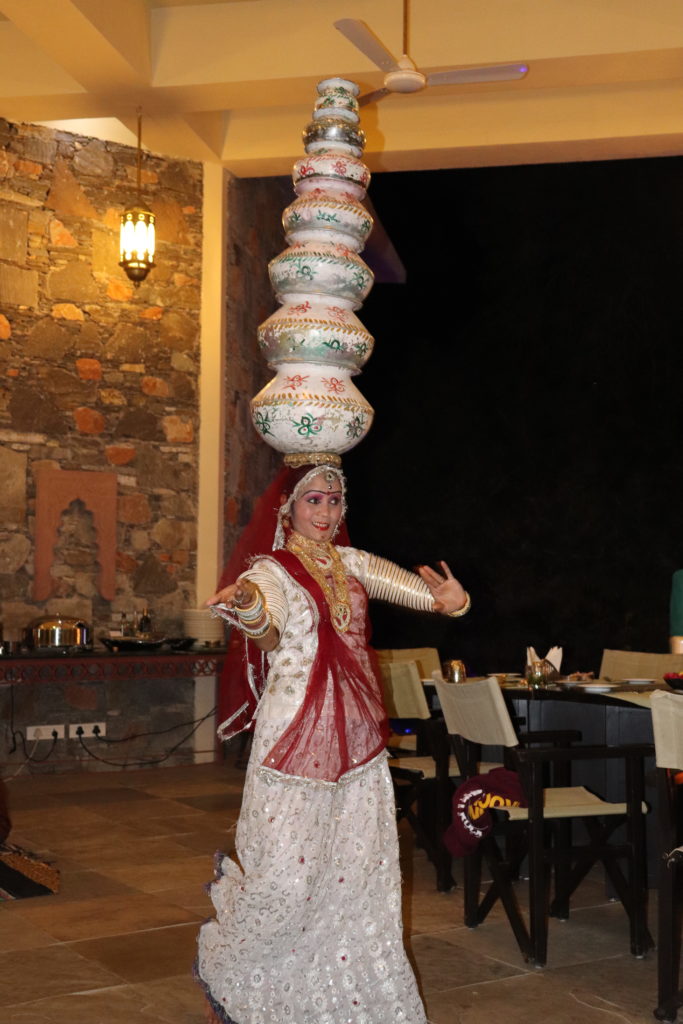
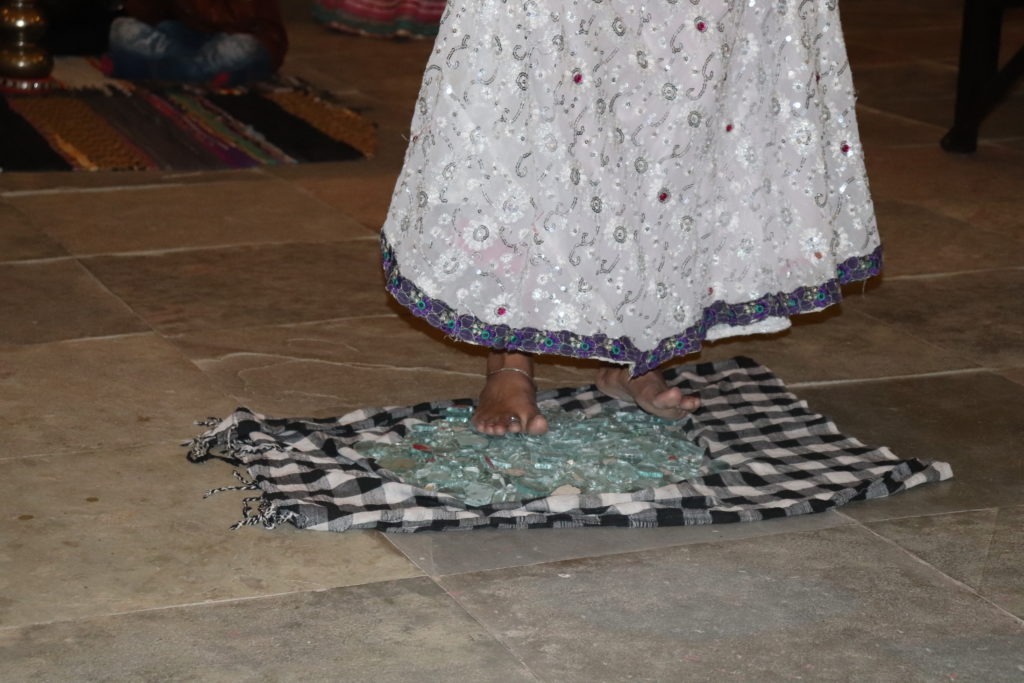
We were very fortunate to have a local village family come to perform local music and dance before dinner. There were two musicians playing chimes and drums, while a smaller boy sat quietly beside the musicians. The woman did a water-bearer dance, starting with a pot balanced on her head. Over the course of the dance, she kept adding pots, until she was balancing 7 pots on her head! And if that wasn’t enough, she began to balance the pots while doing incredible feats. First they brought a pile of broken glass in a scarf and then she proceeded to walk and stomp on it with bare feet. She also balanced on top of two metal cups. She also balanced all 7 pots while she stood on a metal pan, shuffling forward with every step, never dropping the pots on her head.

It was all very impressive. Our facilitator explained that these dances were thought up by the women whose job it was to carry the water on their heads in clay pots, While walking the often long journey from the well, they would plan the dances and then entertain the village. The broken glass and other challenges represented the obstacles the women would face on their journey home, while fetching water for their families.

The family ended the performance with a fire dance as the grand finale. The original woman, plus a younger woman that looked like her daughter, both balanced metal pots of fire on their heads while twirling quickly. It looked very dangerous and very impressive, and they didn’t even hesitate for a moment. Their traditional costumes were intricately made, and they had special make-up adorning their faces.


Leave a Comment

Filed under Uncategorized

India Adventure #5

Mon Dec 24 

We woke up at 6:45 so that we could participate in the “optional” yoga class – as if yoga is ever optional for me. I was a little concerned about my foot, but I did much better than expected. It seems I am still creeping towards a full recovery. After the class was over, I stayed behind to do a bit more yoga and meditate. I cannot adequately describe how it felt to do “sun salutations” while basking in the sunlight as it came over the crest of the hills. I also did my Sa Ta Na Ma Meditation bathed in sunshine. Life is Good.

After a delicious breakfast, we had a short Hindi lesson and then headed into Kalinjar to meet the community. Today was the ribbon cutting ceremony for their brand new classrooms. Usually, there are 214 students who are crammed into 4 small rooms plus the small volleyball court, all on the floor. They are gradually planning on building enough classrooms to house the students comfortably, thirty to a classroom, at desks. It was less than an hour drive from Araveli to the school. The car journey took us through bumpy roads in the countryside, passing small homesteads with livestock, haystacks, young wheat crops and precious little children who waved at the car as we passed. We also cut through narrow streets in tiny towns, where we could barely fit between low-rise buildings, donkeys, cows, monkeys, motorbikes and people carrying supplies on their heads. The journey was fascinating and sometimes nausea-inducing.

At the school, we were again greeted by drumming and singing. More necklaces made of marigolds and another red dot between our eyebrows. The kids were adorable, as expected. They performed a special Hindu ritual of thanksgiving to signify the opening of the school, and some of the kids, dressed up in their finest dresses and jewellery performed traditional dances in celebration of the event. It was a wonderful day, but the highlight for me was the moment after we did the ribbon cutting ceremony when the students flooded the classrooms. I could feel the sheer joy and excitement they had to sit in the desks. 

Another moment that really struck me was when talking to some of the kids, I learned that one of the girls who was dancing for us, eight years old, is already married. The dress she was wearing for the dance was her wedding dress. Her husband is sixteen. Thankfully, she will still Iive with her parents until she reaches the age of maturity at eighteen. She doesn’t know him at all yet, as they are more literally bound by the formal contract of marriage and life together for the future. Child marriage is frowned upon now in India, but in the tribal areas, this century old tradition continues to exist.

We headed back to Araveli for lunch and a short rest, and then headed back at the end of the day to start our first session at the build site. This second drive really forced the use of some ginger for nausea. We had four jobs at the school job site: digging down a foot all along the front of the school for the foundation of the stairs with a pickaxe, then removing the dirt with an Indian shovel; mixing cement; carrying dirt or rocks or mixed cement; and plastering the back wall of the foundation of the classroom. None of us in our group of 12 was particularly great at any of the jobs, but we all worked very hard. In an hour and a half, I felt like we hadn’t really accomplished much, but it was something. We will go back two more times during the trip.

When we returned back to Araveli, there was a surprise waiting for us: two men had brought material and samples, to measure us for custom made Kurtha for the men, and Sarees for the women, for which we each needed to choose a pattern or colour. Of course, they also had other things for sale for very reasonable prices. This is bad news for me as I have such a weakness for textiles. I somehow managed to get away with only spending about $35 and will be going home with some beautiful things.

Reflecting on the day, I feel so very lucky to have had the opportunity to visit the Kalinjar community and share in their milestone. It made me feel so hopeful and happy connecting with these amazing children. Even though we had not yet done anything to deserve any recognition in the opening of the school, we are a part of the team that has built and will build in the future. Even if no formal goals are accomplished in our three build days, we are contributing to a larger project and goal.

Leave a Comment

Filed under Uncategorized

India Adventure #4

Sun Dec 23

In the morning the tale was told of the rock climbing adventure from the previous evening. No one involved uttered the word “lost,” although others interpreted the details in such a way. We took the metro and then found a tuktuk to take us the expected fifteen minute drive to the gym. In typical fashion, the driver claimed to know where we were going, even though it was clear he did not. Thankfully, I had written down the full address and phone number, and he seemed to know the neighbourhood. When we got close, and asked a few pedestrians about the gym, it became clear we were in the wrong area altogether. To be fair, the address was not appropriately specific about the neighbourhood. When we soon go to the right general area, using google maps with Erez’s assistance, we established we were close. We drove around in a circle once and decided it best to disembark and walk through the alley. Then a few times up and down the street before a helpful pedestrian actually knew of the gym and its location. We had already once been to where it should have been (and was) but the address was wrong and there was absolutely no signage. Who would have guessed it was in the back and basement of the school with the long driveway?

The rock climbing gym experience went well. Once we had paid, the boys got their gear and were left to their own devices, as the one staff was busy with other duties and people. Erez and Zev tried bouldering and even climbed a five-storey route from a pit in the floor to to the top of the school chimney. The boys got some advice from local climbers for a few bouldering routes and enjoyed the interactions. I fell asleep on the hard mat in the cold gym for a while.

After conferring with on of the climbers for the best route to the nearest metro station, we set off on foot. It was not entirely clear if the “main street” where we turned was the correct one, so after a few minutes we asked directions. The station should have come relatively soon after the turn and we either missed the station, or the “main street” was further along. The gentleman thought we could not possibly walk to the station, as it was about three kilometres away. I doubted his assessment of our ability and distance and we set out to return to our premature turn and get back on track. About fifteen minutes later, we were at the station. Once we got back to the original road and continued along it, the “main street” became obvious as we met the Ring Road that encircles Delhi. We noted a few men urinating in the street, but no one bothered us.

After our last (sniff!) breakfast at the Spectra Restaurant, we met up with the rest of our group for the WE trip. Everyone was lovely, and we all hit it off right away. We could tell this was going to be a great trip already. We have one more family joining us tomorrow and they have three kids. The family from Detroit has a girl named India, who is the same age as Noam, and her Bat Mitzvah is the week before Noam’s. She is REALLY into rock climbing, so she fit right in with our boys.

We headed to the airport around ten to catch the one hour flight to Udaipur. Then we were picked up for a 2.5 hour car ride to Araveli Camp, the WE headquarters here in Rajasthan, right alongside the Aravalli Mountains. It is absolutely beautiful with pink hills in the distance. We were welcomed by the sound of a drum and tambourine, necklaces of marigolds and roses around our necks, and a red dot between our eyebrows. What a reception!

We were then shown to our “cottage” accommodations and had a scrumptious dinner made by the Chef, Ashant. He explained the meal to us in detail and the food was superb. The facilitators are very friendly, knowledgeable and helpful. We fell into our beds quite early as we were completely exhausted. We are looking forward to tomorrow’s activities.

Leave a Comment

Filed under Uncategorized